
Anxiety Therapy in NYC
Anxiety Therapy for High-Achieving Professionals in New York City
You can be successful, capable, and composed, and still spend far too much time overthinking decisions, anticipating problems, questioning yourself, or struggling to switch off.
Anxiety therapy can help you understand what keeps your mind working overtime and develop a different way of responding to worry, uncertainty, and pressure.
AN EXPERIENCED APPROACH TO ANXIETY THERAPY
Helping High-Achieving Professionals Quiet the Constant Mental Noise

I’m Dr. Michael Brustein, a licensed clinical psychologist with more than 20 years of experience helping people understand and manage anxiety.
Many of my clients are successful, capable professionals who appear composed on the outside, while internally struggling to switch off. They may overthink decisions, anticipate what could go wrong, or put enormous pressure on themselves to get things right.
My approach combines practical strategies with a deeper understanding of what’s driving the anxiety, helping you move through work and life with less internal pressure.
DOES THIS SOUND FAMILIAR?
How Anxiety Can Show Up in High Achievers
Anxiety isn’t always obvious from the outside. For professionals accustomed to performing at a high level, it can show up in more subtle ways.
For high-achieving professionals, these patterns often emerge when expectations aren’t met, things feel inefficient, or you’re carrying more pressure than you realize.
◯ Overthinking Decisions
Analyzing every possibility or revisiting decisions you’ve already made.
◯ Replaying Conversations
Revisiting meetings or interactions and wondering what you should have done differently.
◯ Difficulty Switching Off
The workday ends, but your mind continues reviewing, planning and anticipating.
◯ Fear of Getting It Wrong
Mistakes, criticism or uncertainty can feel disproportionately difficult.
◯ Perfectionism
Holding yourself to demanding standards and rarely feeling completely satisfied.
◯ Always Looking Ahead
Focusing on the next deadline, problem or obstacle instead of the present.
The goal isn’t to stop caring, preparing, or striving. It’s to stop anxiety from determining how much pressure you need to put on yourself.
ANXIETY CAN TAKE DIFFERENT FORMS
It’s Not Always Just Worry
Anxiety can affect how you think, work, interact with others, and experience everyday life. It doesn’t look the same for everyone.
01
Chronic Worry
Persistent concerns about work, relationships, health, or what could go wrong next.
02
Social Anxiety
Feeling self-conscious in meetings, presentations, networking, or social situations.
03
Intrusive Thinking
Unwanted thoughts that are difficult to dismiss, even when you recognize they’re unhelpful.
04
Panic Attacks
Intense physical sensations and fear that can make everyday situations feel unpredictable.
PRACTICAL RESOURCES
Tools You Can Use Right Now
Therapy is only part of the process. These resources offer simple ways to practice mindfulness, slow down anxious thinking, and bring your attention back to the present.
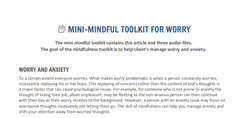
Mini Mindful Toolkit for Worry
A practical resource designed to help you step back from worry, quiet mental noise, and practice mindfulness when anxiety starts to take over.
Guided Mindfulness Audio
Short guided exercises you can return to when you need to slow down, reset, or reconnect with the present moment.
Walking
Ocean
Multiple
Frequently Asked Questions
How do I know if my anxiety is serious enough for therapy?
You don’t need to be in crisis. Many people seek therapy because anxiety is consuming too much mental energy, affecting relationships, interfering with decisions, or simply making life harder to enjoy.
What type of therapy does Dr. Brustein use for anxiety?
Dr. Brustein uses an integrative approach combining cognitive behavioral therapy (CBT), mindfulness, and psychodynamic therapy. Treatment is tailored to your individual needs, addressing both immediate anxiety symptoms and the underlying patterns that contribute to them.
Can anxiety therapy help with perfectionism?
Yes. Anxiety and perfectionism frequently reinforce one another. High standards can create anxiety about mistakes, while anxiety can lead to more checking, preparation, self-criticism, and difficulty tolerating uncertainty. Therapy can address both the immediate behaviors and the deeper beliefs maintaining the pattern.
What if I'm successful and functioning well?
Many people with anxiety function at a very high level. Success doesn’t necessarily reflect how much effort, worry, or internal pressure it takes to maintain that level of performance.
Therapy can be useful even when anxiety isn’t preventing you from succeeding — particularly when you’re tired of how much mental energy success seems to require.
Do you treat panic attacks and social anxiety?
Yes. Dr. Brustein works with several forms of anxiety, including chronic worry, panic attacks, social anxiety, intrusive or obsessive thinking, perfectionism, and anxiety related to work, relationships, and major life decisions.
Do you offer virtual anxiety therapy?
Yes. Dr. Brustein is licensed in New York and New Jersey and is PSYPACT-credentialed, allowing him to provide virtual therapy to clients in participating states.
WHEN YOU’RE READY
You Don’t Have to Wait Until Anxiety Becomes Overwhelming
Many clients begin with a single conversation.
There’s no commitment. Just an opportunity to talk about what’s been happening, what you’d like to change, and whether this approach feels like the right fit.
Or Call 917-847-4217